Thursday, November 26, 2015

MATCH: American Sign Language Workshop


“Thou shalt not curse the deaf, 
nor put a stumbling block before the blind"
Leviticus 19:14
________________________________________________________________


On Wednesday, November 18th, 2:30 to 4:30 PM the MATCH Crip/Queer Working Group held a workshop on American Sign Language (ASL) as part of its initiative to increase familiarity with non-verbal forms of communication. The event was led by Samuel Yates and M.W. Bychowski.

The event began with a brief history of how ASL evolved from the French Sign Language system (which used two hands instead of the one handed English model) before it was brought to the United States as part of a new education initiative. The advantages of ASL included the ability to allow members of the Deaf community to communicate with one another while previous models focused on lip-reading, a process which privileges the hearing as the active user of language and the Deaf as the passive recipient. We discussed Deaf and signing culture, the development of local signs and the creation of artistic practices such as Yale's ASL Shakespeare Project.

Next we learned how to sign letters and some basic words. Each of us learned how to spell our names and introduce ourselves: hello, my name is ______. We learned about the role of facial expressions to punctuate and modify signs. Among the signing etiquette we discussed was the how simulcomming can put the emphasis on the language of the hearing, modifying ASL fit into spoken English and breaking the grammatical rules of signing. In the end, we looked through various options for learning more about ASL through college courses, summer intensive language programs, online tools, text-books, and even smart-phone apps. However each of us moved on from the workshop, however, we all gained a better appreciation of the valuable culture of ASL.

________________________________________________________________


________________________________________________________________

Saturday, November 14, 2015

Call for Papers: Composing Disability 2015-2016

___________________________________________________

Composing Disability 2015-2016
"Crip Ecologies"
Thursday, April 7 - Friday, April 8, 2016

___________________________________________________

REVISED DEADLINE:
The new abstract deadline for GW's Crip Ecologies conference is October 31.

George Washington University’s biennial Composing Disability Conference returns in Spring 2016 with the theme of "Crip Ecologies." The event will be held April 7-8, 2016; featured speakers include Sunaura Taylorand Riva Lehrer, with others to be announced soon. Crip Ecologies is sponsored by the Vice Provost for Diversity and Inclusion, the Columbian College of Arts and Sciences, Disability Support Services, the Department of English, the University Writing Program, the GW Medieval and Early Modern Studies Institute (GWMEMSI) and the GW Digital Humanities Institute (GWDHI).

We invite proposals for papers and panels for this event. 250-word abstracts for papers and 500-word abstracts for complete panels should be sent by October 15, 2015 to cripecologies@gmail.com

Deadline for Abstracts: October 31, 2015

___________________________________________________

Crip Ecologies: This symposium seeks to bring together scholars, artists, advocates, and activists working across the fields of ecocriticism, disability, and queer studies. Our goal is to think through the queer interchanges of environments and bodies in more radical ways. As vulnerable embodied beings that interact with our environments, we experience ourselves and others through a defining porosity: we are not only affected by the places we inhabit, but we also leave our imprint on these locations as well. Marginalized subjects, including disabled people, often experience their lives in greater proximity to environmental threats such as toxicity, climate change, generational exposures to unsafe living conditions due to poverty, militarization, body exhausting labors as in the case of migrant workers, etc. Further, we seek to investigate how non-normative bodies/minds can reframe what it has historically meant to be an environmentalist or "nature lover?” Crip Ecologies will draw out these wanted, unwanted, and even unknowable intimacies with our environments as materials for new trans-historical, cross-cultural, and crip/queer research about human, non-human, organic, and inorganic relationships that mark our experiences in the world.

___________________________________________________
Possible topics include:

Composing Crip Ecologies
Crip Ecologies and Militarization/War
Crip Ecologies and Art
Crip Ecologies and Localism
Crip Ecologies and Environmental Justice
Crip Ecologies and Food Justice
Crip Ecologies and Farming
Crip Ecologies and Racial Borderlands
Crip Ecologies, Time, and Places
Crip Ecologies and the University
Toxicity, Embodiment, and Uneven Development
Queercrip Bodies in the Global South
Disaster Capitalism, the Environment, Disability
Entanglement Theory
Media Studies and Digital Interfaces
Crosscultural and Transhistorical Worldings
Race, Class, and Environmental Justice
Accessibility and Ecological Backlash
Politics of Racial/Crip/Queer/Trans Spaces
Intersectional Bodies and Policing in Security States
Class and Toxic Exposures under Neoliberalism
Rhetorics of Inclusion/Biopolitics of Exclusion
Non-productive Bodies and Alternative Practices of Everyday Life
Expendable Bodies and Economies of Neglect (Necropolitics)
Crip Mental Health Ecologies

For more information about the Composing Disability series at GW, visit this page on the Disability Support Services website and explore the Composing Disability tumblr site. You can also follow Composing Disability on Twitter (@ComposingDis) or join the community on Facebook.

Thursday, October 22, 2015

Karen Nakamura: Cultural Madness: Notes on an Anthropology of Psychosocial Disability


A Talk by Karen Nakamura 

_______________________________________________
_______________________________________________


On October 22nd, 2015, Karen Nakamura spoke on "Cultural Madness: Notes on an Anthropology of Psychosocial Disability" at the Center of Media and Public Affairs at the George Washington University. The event was co-sponsored by the English Department's Crip/Queer Studies programming and Disability Student Services. David Mitchell introduced Nakamura, noting her recent work, Disability of the Soul, and her upcoming project on Transgender in Japanese Culture. Nakamura opened with a call for more disability studies within the field of Anthropology, especially projects focused outside the United States. The speaker subsequently discussed her work with Bethel, an intentional Christian community in Japan that supports a wide variety of peoples with psychosocial embodiments, including schizophrenia and depression. The subject of Nakamura's documentary, "Bethel: Community and Schizophrenia in Northern Japan," was a group of neuro-divergent and neuro-queer persons living in a small town attached to a hospital and university. It was from this population of outpatients that the Bethel intentional community arouse to promote mutual support and dialog. As the name suggests, Bethel was sponsored and founded by a Church group who wanted to affirm non-privatized, non-medical alternative forms of care in order to compliment and contrast the medical practices of the hospital. Modeled on programs such as Alcoholics Anonymous, Bethel members would meet, share stories, offer assistance and accountability, and consider their relations to society and the wider world.

While many academics might be suspicious of non-medical, Christian programs working with disabled communities, Nakamura found numerous positive alternatives that the socio-religious model offers over the privatized medical model. Rather than drug away the power of those with psychosocial illnesses or incarcerating (or otherwise institutionalizing) them in ways that isolate them and limit their agency, Bethel stresses social and cultural methods that reaffirm relationships. After persons with psychosocial traits become alienated from friends and family either by symptoms or by medical and legal agencies, Bethel works with the person to help bring them back into community, reestablish social bonds, and creating a sense of family. Nakamura offered critiques as well. As a "total institution," the Bethel community creates a kind of dependency on its programming. There are few options to take some but not all of the assistance the institution offers. You are either all in or all out. Furthermore, Bethel promoted a world-view of suffering oriented towards a release into oblivion. Also, the Bethel community remains fairly conservative in its view of gender and sexual politics, limiting the forms of relation and embodiment of its members. Finally, Nakamura explained, the Bethel model is difficult to duplicate due to its ready made population drawn from the hospital's outpatients and inpatients.
_______________________________________________
_______________________________________________


_______________________________________________
_______________________________________________

Wednesday, October 21, 2015

MATCH: Cripistemologies


"How, when, where, and why do queer, feminist, and disability epistemologies converge?

"Proliferating Cripistemologies: A Virtual Roundtable" 
by Robert McRuer and Merri Lisa Johnson.
_______________________________________________

On October 21st, MATCH's Crip/Queer Reading Group met to discuss "Proliferating Cripistemologies: A Virtual Roundtable," composed by Robert McRuer and Merri Lisa Johnson for GLQ, Volume 8, Issue 2, 2014. The curated roundtable included contributions from Lennard Davis, David Serlin, Emma Kivisild, Jennifer Nash, Jack Halberstam, Margaret Price, Rosemarie Garland-Thomson, Jasbir K. Puar, Susan Schweik, Jennifer James, Lisa Duggan, and Carrie Sandahl. The diversity of the participants reflected the intersections and divergences of many different trajectories in the node of crip knowledges, including feminism, queer studies, phenomenology, marxism, anarchism, and critical race theory. Each scholar brought their own questions and concerns to the table, "What tensions or torsions exist among various cripistemologies? Are certain forms of queer (anti)sociality, for instance, in discord with interdependency as it has been imagined and materialized by feminist disability studies? Are there crip positions, embodiments, or moments of pain or pleasure that necessarily exceed the (compulsory?) identities or identifications of rights-based movements?"

In turn, the members of MATCH echoed the multiplicity of movements that meet in the node of cripistemology. Debates arouse around the utility and danger of identity based politics, rights versus justice tactics of activism, the uniqueness of subject positions and "the situated i" that is always already in relation, as well as the role of systems of government and the free market. The members of the reading group posed their own critical insights and questions as well, drawing out themes relating to post-colonialism, performance studies, transgender studies, and medieval theology. In the end, the definition or use of cripistemology was left uncertain but furthered each of our thinking and produced new collective insights.

_______________________________________________
_______________________________________________

_______________________________________________
_______________________________________________

Thursday, September 17, 2015

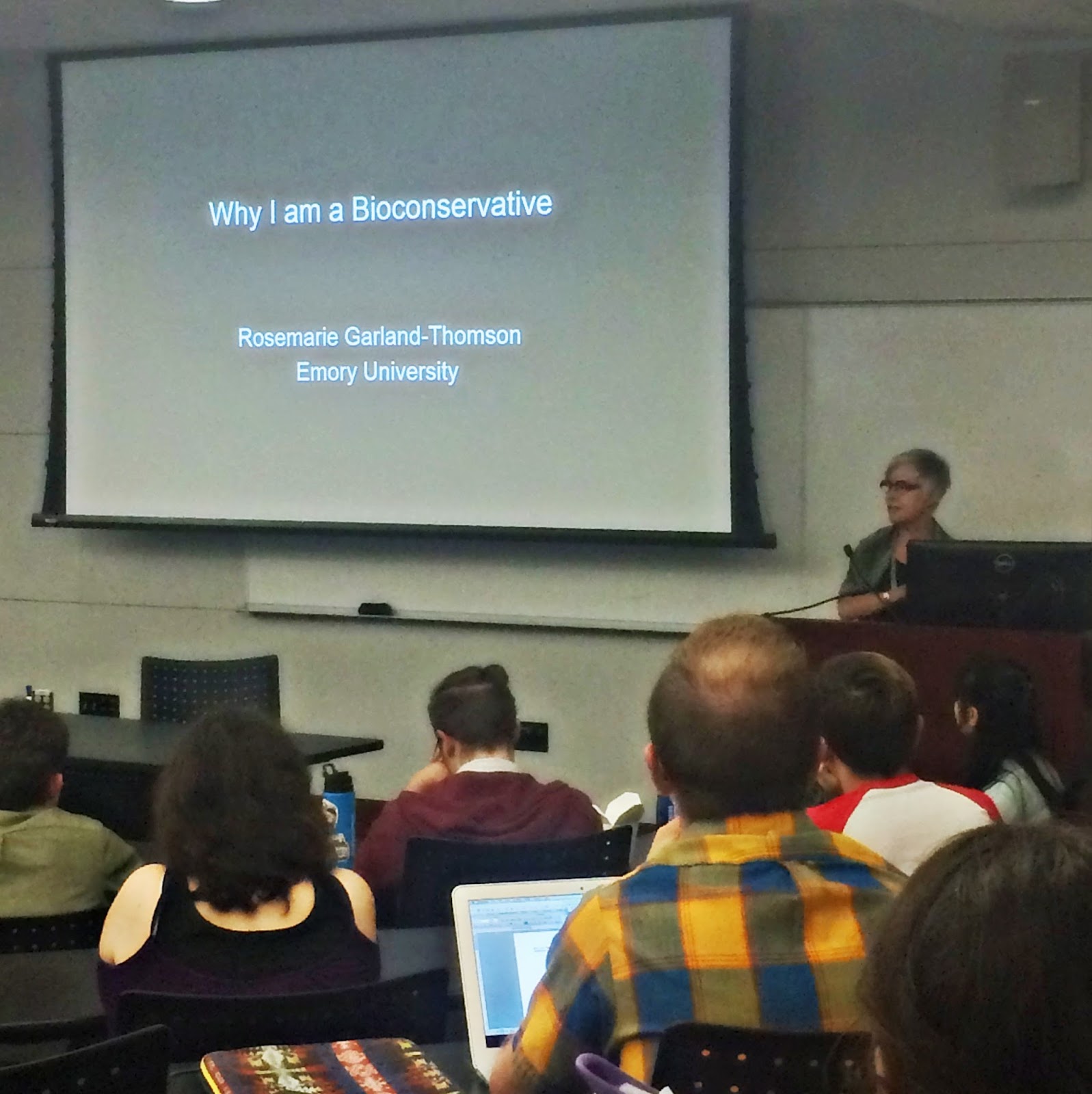
Rosemarie Garland-Thomson: "Why I am a Bioconservative"


A Talk by Rosemarie Garland-Thomson 
_______________________________________________
_______________________________________________


On Sept. 17th, 2015, Rosemarie Garland Thomson spoke on "Why I am a Bioconservative" to a packed lecture hall at the George Washington University. The event was coordinated by the GWU English Department as part of its Crip/Queer Studies programing. David Mitchell introduced the speaker, praising her as a foundational figure in Disability Studies, authoring such influential texts as Freakery, Staring: How We Look, and Extraordinary Bodies. In an hour and a half, Thomson spoke on the important but often unspoken alliance between religious conservatism and non-religious disability activists around "Pro-Life" issues, specifically the abortion of fetuses to be born with physical or mental impairments, euthanasia, and the assisted suicide of the disabled.

By opposing not only the use but the cultural indoctrination of eugenics, disability activists find themselves joining forces with religious conservatives. Thomson contends that while religious and non-religious "bioconservatives" may disagree in first principles, these groups join together in their conclusions. For instance, "dignity" is a key issue within bioconservatives of either ilk. In this context, dignity designates a life worth living and deserving of "moral personhood" (rights and duties) as well as a "quality of life" (well being in medical care, politics, and employment). Religious and non-religious groups may disagree in the source and authority that bestows dignity: humanity or God. Nonetheless, persons of different belief systems can help preserve the dignity of those marked as undesirable: those who are "too expensive" in relation to their social worth.

Thomson stressed the important cultural work of bioconservatism that promote a culture of life. In particular, ritual practices such as the washing of bodies are acts of care common among religious and non-religious communities. Washing in hospitals, elderly care facilities, families by caregivers, as well as the sacramental blessing of children, the sick, and the dead are all examples of rituals that recognize the dignity of the bodies they encounter. Such rituals recognize the dignity of embodied experiences, Thomson argued. Through repetition, rituals directly create the conditions for a quality of life while affirming moral personhood. If washing were more openly a communal practice where the reception of care is a sign of dignity rather than shame, fewer people would be instilled with the belief that they would rather be dead than unable to clean themselves. 
_______________________________________________
_______________________________________________


_______________________________________________
_______________________________________________

Friday, April 4, 2014

Composing Disability 2013-2014


“Composing Disability: Diagnosis, Interrupted”

3-4 April 2014 / Jack Morton Auditorium / 801 21st Street NW

This conference will take as its focus the fifth edition of the Diagnostic and Statistical Manual of Mental Disorders (2013) by examining the fraught relationship between the diagnostic work of the medical industry and the embodied lives of disabled people. The conference will conclude on Friday evening at the 5th and K Street branch of Busboys and Poets, where an intimate group of DC-based poets and performers will read disability-themed poetry.

Featured speakers include:
Ellen Forney, author of Marbles: Mania, Depression, Michelangelo, and Me
Ann Cvetkovich, author of Depression: A Public Feeling
Katie Rose Guest Pryal, author of A Short Guide to Writing about Law

Sunday, January 13, 2013

MATCH: Queer Phenomenology


Queer Phenomenology
by Sara Ahmed
_____________________________________________

The fourth meeting of MATCH was held at the end of January to launch the Working Group into a series of discussions on "Making It Personal," culminating in a Round-Table on "Attitudes, Affects and Alliances in Scholarship" to be held as part of the Temporal Slippages and Spatial Slidings Symposium in Washington DC on February 15th.

In reading Ahmed's Introduction "Getting Into It," we followed up on her invitation to consider how we come to occupy certain spaces and take on certain forms of occupation in response to different "things" which orient us. Those present developed a working list of "things" that seem to have us in their gravitational pull, simultaneously informing our scholarship but with a life and a livelihood outside it.

At times, Ahmed notes, we become formed and directed by dis-orientation and an expulsion from spaces which seem to allow certain bodies to extend and not others. We discussed how such "queerness" launches us on certain trajectories which in turn orient and re-orient us. The idea of objects which move with us became particularly important at this time, occupations which demand that we remain constantly on the move.

In turn, we thought about identity as the inscription of these lines of movement, push and pull, on our bodies and how different things "stick" to us like glue or else slide off us as a result of taking on these identity positions. Without a doubt, scholarship becomes a large gravity well which pull in a lot of our life, but these too can and often does exist either in competition with or in orbit around other "things" which hold a stronger sway on us at this time.

_____________________________________________

_____________________________________________

A Crip/Queer Working Group
_____________________________________________

_____________________________________________